How Big Should Your Event Branding Be in Malaysia?
One of the most common mistakes in event branding is choosing the right product but the wrong size.
A giant balloon that is too small for the venue fails. A skydancer that is too short for the roadside gets ignored. A balloon arch that is out of proportion to the storefront looks like it belongs to a smaller event. Buyers usually notice this only on the day — when the setup is already installed and the venue makes the problem obvious.
Getting size right is not about spending more. It is about understanding how scale works in the specific environment your event occupies.
The practical rule: better to install fewer, larger, correctly scaled pieces than many undersized ones.
Why Sizing Matters More Than Buyers Expect
Most buyers ask which structure they should use. Fewer ask what size it should be.
But size is often the difference between visible and forgettable, professional and underwhelming, worth photographing and easy to ignore.
A structure that is too small does not only reduce visibility. It weakens the perception of the event itself. It makes the setup feel less intentional, less confident, and less suited to the venue.
This happens most often when buyers choose based on budget first — or assume that a crowded venue justifies smaller branding. In reality, crowded venues usually require stronger scale, not weaker scale. The more visual noise in the environment, the more the installation needs to rise above it.
The Primary Sizing Factor: Ceiling Height vs Installation Height
Before anything else — product type, colour, quantity — the relationship between ceiling height and installation height determines whether a structure reads correctly in the venue.
The practical principle: the taller the ceiling, the taller and wider the installation needs to be to maintain the same visual weight. A structure that commands a standard function room looks lost in a convention hall or mall atrium unless the proportions are recalibrated for the new environment.
At Wonder Balloons Malaysia, the first question when a client calls about sizing is: what is the ceiling height of the venue? Everything else follows from that answer.
For open-ground and roadside events where there is no ceiling, the primary factor shifts to viewing distance — how far away the installation needs to be detectable.
Five Factors That Shape the Right Size
Before confirming any installation dimensions, these five factors determine what will actually work.
Viewing distance. The farther away the structure needs to be noticed, the larger it needs to be. This applies most directly to roadside activations, mall atriums with multi-floor sightlines, and open public grounds.
Surrounding visual clutter. A structure may be technically large but still disappear against competing mall graphics, roadside signboards, or heavy seasonal décor. In cluttered environments, size must overcompensate for competition.
Crowd density. Once a crowd forms, anything competing at eye level disappears. Structures that do not rise above normal human height are invisible from behind the first row of people.
Event scale. A setup that looks appropriate for a small private function looks weak at a marathon, public activation, or major property launch. The more public the event, the more the structure needs to carry visual authority.
Sponsor or brand expectations. For sponsor-funded events, property launches, and high-value activations, the installation must also communicate that the brand behind it is serious. Size is part of that signal.
Sizing for Exhibition Halls
Exhibition halls at MITEC, KLCC Convention Centre, and Setia City Convention Centre are the most demanding sizing environment in Malaysian event branding.
Ceiling heights typically run from 8 to 15 metres. Every booth on the floor competes at the same 2.5 to 3-metre build height. An installation that does not rise significantly above that level is invisible from across the hall — it disappears behind neighbouring booths before anyone reads the brand.
Giant balloons are the most effective far-zone tool in exhibition halls because they operate above booth height entirely, floating or suspended at a level where nothing else competes. The question is not just diameter. It is whether the balloon, at its intended suspension height, is large enough to read clearly from across the hall — not just impressive up close.
Inflatable arches at exhibition booths serve a different function. They frame the booth entrance and create the visual threshold. The mistake buyers make is ordering an arch sized for a doorway rather than an entrance within a hall with a 10 to 15-metre ceiling.
The general rule in exhibition halls: if you think the size is right, scale up. The ceiling almost always demands more than the initial estimate.
Sizing for Mall Atriums
Mall atriums are deceptive environments. They feel manageable in a floor plan and manageable from within a single corridor. Stand in the atrium, look up, then look across from the upper floors — the sightlines change the calculation entirely.
Atrium heights in Klang Valley malls typically range from 10 to 20 metres. Critically, the atrium is visible from multiple floors simultaneously. An installation sized for the ground floor audience alone does not read from the third or fourth floor looking down.
For indoor mall use, giant balloons typically need to be in the 6ft to 8ft range at minimum to hold visual presence in larger atriums. Below that, the impact drops quickly unless the placement is exceptionally favourable.
Balloon arches in mall atriums need to be wider than most buyers initially estimate. An arch spanning the full activation zone commands the floor and reads across multi-floor sightlines. A narrow arch at standard width becomes a decorative element when viewed from the upper levels.
The starting question for mall sizing: which floors have a direct sightline to this installation, and what does it need to look like from each of them?
Sizing for Roadside Activations
For roadside branding, the two strongest factors are movement and competing visual clutter.
A roadside activation sits beside shop signs, billboards, bunting, vehicle movement, and neighbouring businesses all fighting for the same glance from passing traffic. In this environment, still structures need strong scale, and moving structures need enough height to rise above the noise.
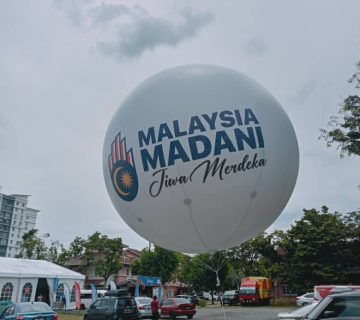
Giant balloons for roadside use: the practical working range is 10ft to 15ft. Below 8ft outdoors, the visual return is generally not worth the cost. At 12ft to 15ft the installation starts working properly. At 20ft — with the right blower and anchoring system — the visibility is significantly stronger.
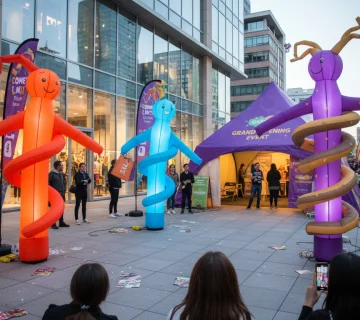
Skydancers for roadside use: height is the primary variable. The useful range is 12ft to 15ft. Anything shorter tends to lose effectiveness quickly against real roadside clutter. A skydancer that is too short may still move, but it does not create enough interruption to function as a genuine visibility tool rather than decoration.
The roadside sizing rule: always design for the driver who is 50 to 100 metres away, not the pedestrian who is already standing in front of the unit.
Sizing for Open Grounds and Public Events
In open public grounds — property launches, government campaigns, outdoor roadshows, community days — there is no ceiling to reference. The relevant variable shifts to event scale and viewing distance.
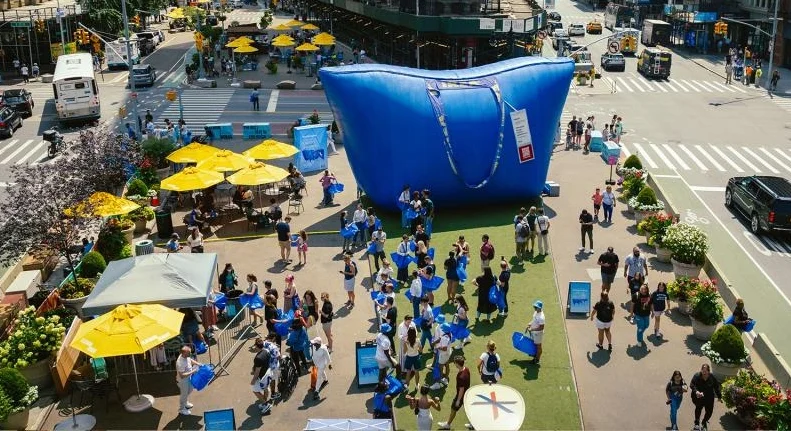
Wide open venues make medium-sized installations look smaller than expected. A structure that feels substantial in a warehouse or a compact car park looks modest in a public field or stadium compound.
For open-ground events, giant balloons may need to be toward the upper end of the recommended range. Multiple zone markers often perform better than a single weak focal point across a large area.
Inflatable arches also scale differently depending on the event type. For roadshows, 15ft to 20ft is a practical range. For marathons and large public runs, 30ft to 40ft is more appropriate — because a marathon arch is not only an entrance feature. It is part of the route identity, sponsor photography, and event authority that the race communicates over several hours.
Balloon Décor: Proportion, Not Just Absolute Size
With balloon arches and garlands, the problem is often not absolute size. It is proportion to the space.
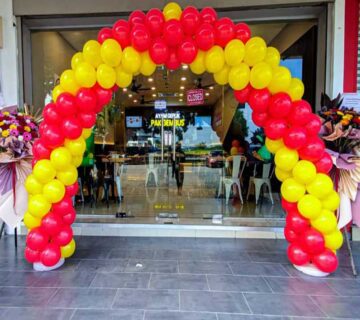
A balloon setup can be technically wide enough and still look visually thin or weak if the balloon mix gives it insufficient depth and fullness, or if the width does not match the height and breadth of the storefront or backdrop it is framing.
A professional balloon installation looks right when it frames the entrance properly, matches the architectural scale of the space, and has enough visual weight to read as intentional rather than decorative.
This is especially important for grand openings, café launches, mall unit activations, and entrances where the décor is expected to anchor the photography.
The Photography Test
One practical check that applies across all venue types: size for the camera angle, not just the live audience.
Event photography is typically shot from a distance that includes the full venue in the frame. An installation that looks proportional to the people standing in front of it may still appear modest in a wide-angle venue shot — which is the image that gets shared, published, and seen by more people than attended the event.
For any event where media coverage, social documentation, or client photography is part of the objective, the installation needs to read correctly at the distance a camera captures, not just at handshake distance.
Common Sizing Mistakes
Referencing supplier photos without checking the venue dimensions. A photo of an installation at another event is not a sizing guide unless the ceiling height, room width, and viewing distances match your own.
Deciding on budget before confirming venue dimensions. The venue should determine the minimum effective size. A correctly sized installation within a tighter budget — achieved by simplifying the design rather than reducing the scale — performs better than an undersized premium piece.
Assuming crowded venues justify smaller branding. The opposite is usually true. Dense crowds demand more vertical scale, not less.
Sizing for the empty venue, not the event at capacity. An installation that reads correctly in an empty room will feel smaller once the event is full and crowds are blocking sightlines.
Not asking the supplier directly. A supplier with genuine event experience will flag sizing concerns before the order is confirmed. Ask directly: is this size appropriate for my ceiling height and viewing distance?
How Wonder Balloons Approaches Event Sizing
Sizing is part of the brief at Wonder Balloons Malaysia — not confirmed after the order is placed.
When a client tells us the venue, we ask about ceiling height, viewing distances from different positions in the space, surrounding visual competition, and which sightlines matter most. For first-time corporate buyers, we work through the sizing logic before any dimensions are locked in.
The goal is not to upsell scale for its own sake. It is to make sure the installation is large enough to do the job it was bought to do.
Planning an Event Installation?
Get in touch with Wonder Balloons Malaysia to discuss sizing, venue assessment, and installation planning for your next event.
👉 Enquire about our services with Wonder Balloons Malaysia today.